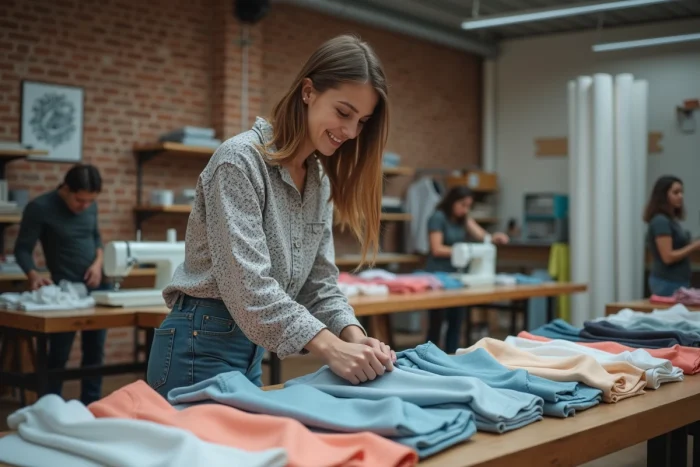
The United Kingdom imposes strict standards on its fashion retailers, but the majority of the clothing sold by major platforms is not produced there. Asos, a major player in the industry, collaborates with over 700 factories spread across more than 20 countries. Quality controls and social audits are frequent, but supply chains remain complex and sometimes controversial.
Some limited collections are made locally, while the current production mainly comes from Asia and Eastern Europe. The differences in manufacturing directly influence the diversity of materials, the finishing of products, and ultimately, their positioning in the global market.
Asos: a British signature that has become a global phenomenon
In 2000, in London, Nick Robertson and Quentin Griffiths launched an online fashion site at a time when digital habits were still in their infancy. Their bet? That everyone could afford the outfits spotted on celebrities. Two decades are enough to develop Asos into a giant: over 85,000 references, 850 partner brands, and, as early as 2004, a private label that became popular among trendy youth, and later among a more eclectic audience through vintage ranges and a marketplace open to independent creators.
The attachment to the UK remains strong (80% of sales), but Asos is no longer limited to the island: 10 languages, 200 countries served, and a growing workforce that boosts London’s figures. This success is based on impeccable logistics, a dynamic digital strategy, and an ability to capture the zeitgeist on social media. The real strength of the group? Having been able to rethink its offer and its manufacturing methods at every stage of its growth.
The topic of the origin and country of the Asos brand regularly comes up among the concerns of attentive customers. To respond to the demand for information, Asos relies on the variety of its factories and the transparency of its supply chains, not hesitating to relocate part of the production to the UK. Balancing claimed fast fashion with responsible initiatives, Asos walks a fine line, always under the scrutiny of consumers and industry analysts.
In which countries does Asos manufacture its clothing?
To produce its collections, Asos relies on a global network of subcontractors. Textiles today are a globalized puzzle where each country has its specialty. Here are the key areas in manufacturing:
- China: the indispensable source, particularly for cotton and polyester, known for its ability to provide huge volumes at very low prices.
- Bangladesh and India: two giants in garment production, efficient for quick deliveries thanks to a skilled workforce and proven know-how.
These pillars are joined by other essential partners: Turkey and Vietnam for their proximity to Europe and their flexibility to absorb trends, as well as factories in Eastern Europe that are gaining strength, particularly for small batches requiring tracking and flexibility.
Asos has not settled for a broad approach: a portion of production is now returning to Great Britain. The result: more responsiveness regarding deadlines, a touch of national pride, and a card to play with local customers keen to support home-based work.
Some projects take on another dimension. For example, with the Soko collective in Kenya, the “made in Kenya” collection goes beyond simple origin: it highlights the skills of local artisans, promotes values of autonomy for women, and aligns with the demand for ethics and transparency expressed by a generation eager for meaning. From a simple garment, Asos thus makes a banner of its social commitment.

Geographical diversity, quality control: the Asos method
At Asos, managing production does not mean seeking the cheapest option at all costs: each area of the globe has its place for a specific reason, and the map of partner sites evolves with crises, geopolitics, health issues, or logistics challenges. This model is flexible but requires constant vigilance, thorough controls, frequent social audits, and quick responses if a factory goes off track.
Traceability, long kept confidential, has now come to the forefront: public information portal, detailed annual reports, open listing of factories, Asos relies on transparency to reassure. Regular audits and labels like BSCI or SA8000 define the standards imposed on each workshop.
Another crucial point: environmental commitment. Asos is now part of the Better Cotton Initiative, prioritizes recycled materials, supports organic cotton, and strives to reduce pesticides and carbon impact in the textile chain. While climate neutrality remains a distant goal, every advance counts, from water management to tracking micro-particles from synthetic fibers.
The demand for quality also extends to collaborations, regardless of their size. Whether an Asos garment comes from Leicester or Dhaka, the stated goal remains the same: quality, traceability, and respect for people.
Asos does not promise perfection or absolute purity, but claims this stubborn vigilance, this refusal to turn a blind eye. Behind each piece, there is now a country, an approach, a story to decipher, and a different way to look at one’s wardrobe in the morning.