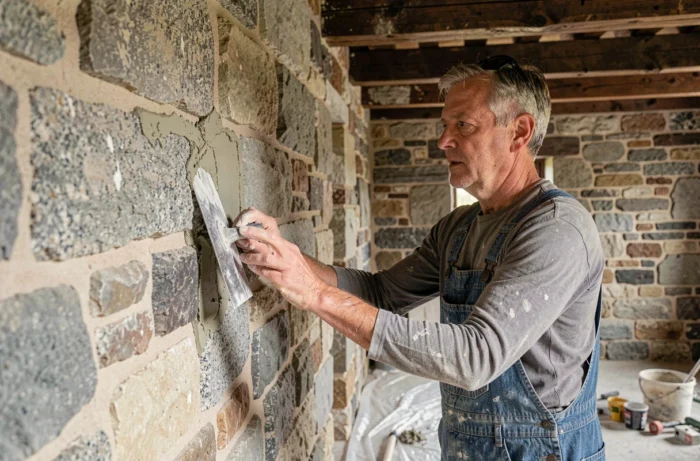
A Breton house wall made of granite or schist, bonded with earth or lean lime, functions as an open system. It absorbs water, stores it, and releases it. Any intervention that ignores this hygrothermal cycle merely shifts the problem instead of solving it. Renovating the walls of a Breton house requires a diagnosis before touching any coating.
Moisture Diagnosis of Stone Walls: The Step Often Omitted in Estimates
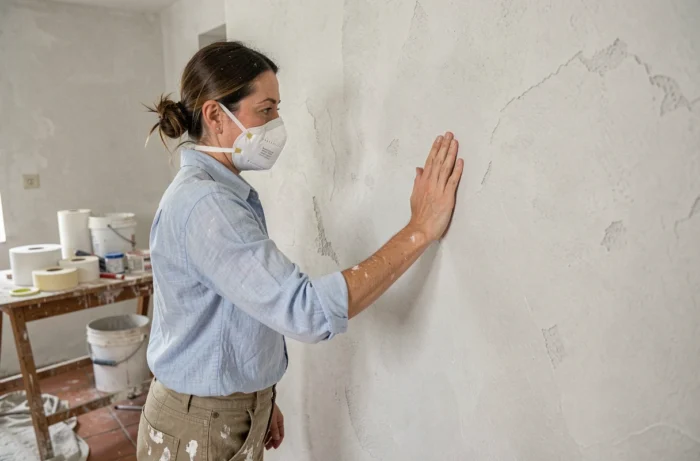
We regularly observe sites where interior insulation has been installed on a wall still saturated with water. The result becomes apparent two winters later: mold behind the lining, crumbling bonding mortar, persistent damp smell.
Moisture is not part of the mandatory technical diagnostic file. Unlike asbestos, lead, or the energy performance diagnosis (DPE), no official document informs the buyer about the actual moisture condition of the walls. The approach must therefore be voluntary and conducted before any decision on work.
Identifying the source of the water is the first operation. The possible sources are distinct and each requires a different treatment:
- Capillary rise, common in old masonry lacking a waterproof barrier at the base, is identified by a regular damp front at the lower part.
- Facade runoff, exacerbated by exposure to prevailing westerly winds, attacks degraded joints and infiltrates the interior blocking.
- Indoor condensation, linked to a ventilation defect or poorly positioned insulation, generates water on the cold side of the wall.
Once the cause is established, we recommend allowing the masonry to dry before applying any coating or insulation. Placing a corrective layer on a wet wall amounts to trapping the water within the wall.
Those wishing to renovate the walls of a Breton house should treat this phase as an investment, not as an unnecessary expense. A reliable moisture diagnosis is crucial for the durability of everything that will be installed afterward.
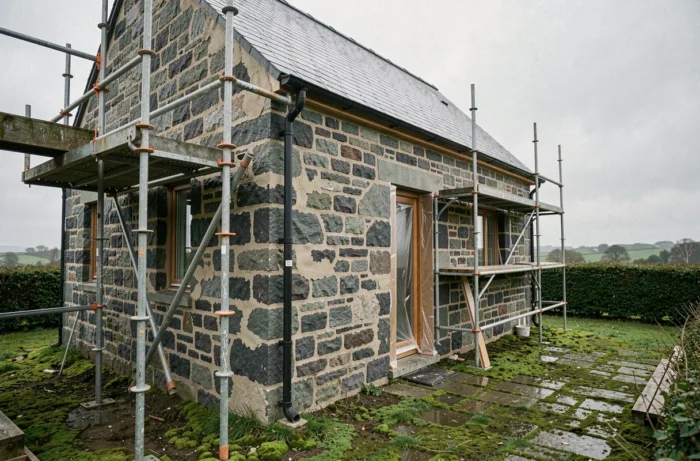
Coatings and Binders Compatible with Granite or Schist Masonry
A cement coating on an old stone wall is the most common technical mistake. Cement is impermeable to water vapor. Moisture trapped in the masonry can no longer migrate outside: it rises, bypasses the coating, and emerges higher or further away, causing damage that is difficult to locate.
Aerial lime or natural hydraulic lime remain the reference binders for traditional Breton walls. Their porosity allows for vapor exchange in both directions. Lime mortar closely resembles the original mortar in its flexibility and permeability, which limits mechanical stress on sometimes irregular stones.
Lime-Hemp and Earth Coatings: Two Options to Consider
The lime-hemp mix combines insulation and breathability. It can be applied in varying thicknesses depending on the desired performance and is well-suited for moderate thermal corrections. The Cerema cites this type of bio-sourced solution among the compatible associations with old buildings.
Earth coatings, rarer in renovation, offer even superior hygrometric regulation. However, their mechanical fragility limits them to interior walls protected from shocks. Each interface (wall, coating, insulation, floor, ventilation) must be considered as a coherent whole, not as a succession of independent layers.
Interior Insulation of Breton Walls: The Traps of Insulation Choice
Insulations designed for new construction (polystyrene, mineral wool with a waterproof vapor barrier) work on a hollow wall with a capillary break. On old masonry, they create a condensation point at the wall-insulation interface. Liquid water accumulates without being able to drain away.
A breathable insulation installed without a ventilated air gap on the wall preserves the drying cycle. Wood fiber panels, expanded cork, or sprayed lime-hemp mixtures are among the compatible materials. The choice depends on the available thickness, the wall’s exposure, and the desired thermal performance level.
Two common mistakes deserve mention. The first is installing a vapor barrier that is too airtight on the interior side of a wall that absorbs water from the ground: moisture remains trapped between the vapor barrier and the stone. The second is insulating without correcting the ventilation. Without sufficient air renewal, any interior insulation worsens condensation.
Site Conditions in Breton Climate: Temperature, Rain, and Schedule
The implementation of lime mortars and coatings requires conditions that the Breton climate does not guarantee year-round. Below five degrees, the carbonation of aerial lime slows significantly, or even stops. A coating applied in cold weather does not harden properly and deteriorates with the first rains.
Excess ambient humidity poses a symmetrical problem. A coating that does not dry quickly enough remains vulnerable to nighttime frost, even if daytime temperatures seem acceptable. We recommend planning exterior coating work between April and October, monitoring the ten-day forecasts.
Protecting Facades During Drying
On west-facing facades, an air-permeable cover protects the fresh coating from heavy rain without blocking evaporation. Waterproof plastic tarps should be avoided: they create a greenhouse effect that prevents drying and promotes efflorescence.
A well-carbonated lime coating then withstands Breton weather without difficulty. The issue is not the material, but the timing and protection during the curing phase.
The renovation of the walls of a Breton house does not tolerate improvisation. Moisture diagnosis, choice of breathable binders, compatible insulation, and a construction schedule adapted to the climate form a logical sequence. Skipping a step or reversing the order compromises the durability of the whole, sometimes irreversibly.