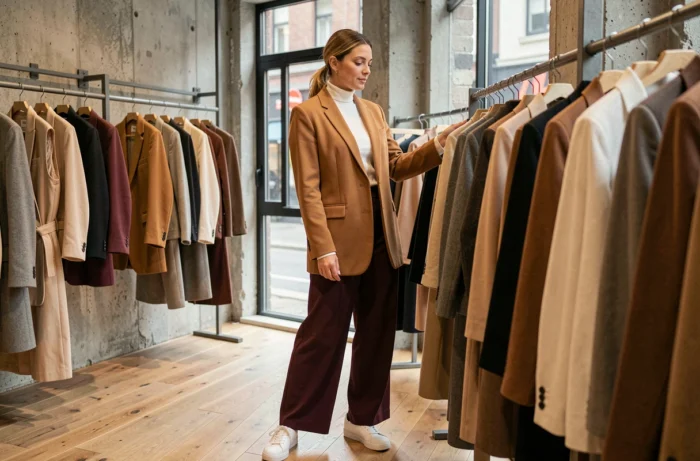
Seasonal fashion is defined by a renewal of silhouettes, materials, and color palettes presented by fashion houses and brands during shows and collections. For autumn-winter 2026-2027, fashion trends oscillate between romantic references (lace, bows, dark floral patterns) and bold cuts that structure the everyday wardrobe.
European textile regulation: what changes for the autumn-winter wardrobe
Before discussing style, a recent legal framework is changing the way clothing is produced, sold, and communicated in Europe. These rules directly influence the available offerings in stores and the arguments of brands.
Since July 2026, the ESPR prohibits large companies from destroying certain unsold textiles, whether they are clothing, accessories, or shoes. The system favors resale, donation, repair, or reuse. Medium-sized enterprises will be affected starting July 2030.
The revised European framework directive on waste requires member states to transpose the new rules by June 17, 2027, with operational systems in place by April 17, 2028, at the latest. Producers’ contributions should be adjusted according to the sustainability, reparability, recycled content, and recyclability of the items. Choosing a sustainable coat means anticipating what the law will encourage.
Environmental arguments are becoming increasingly difficult to use in fashion communication: the new European rules against greenwashing strictly regulate environmental claims. A brand that claims to be “eco-responsible” without verifiable proof is subject to sanctions. For those following fashion trends on Mademoiselle Emma, this evolution makes the information available on collections more reliable.
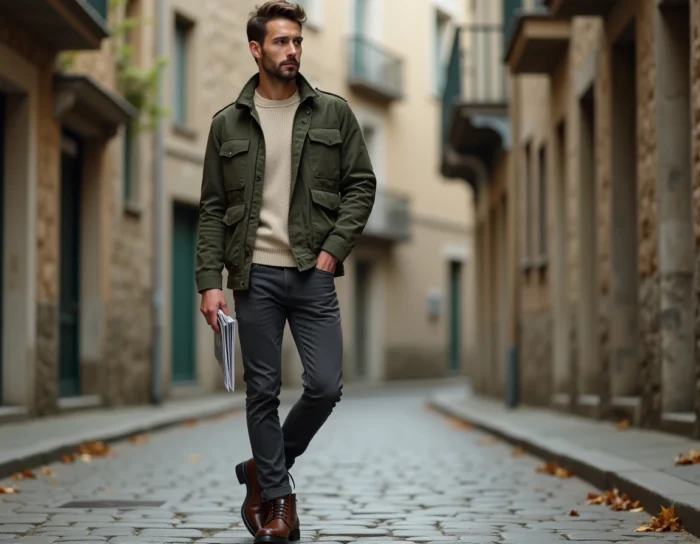
Key patterns and colors for the autumn-winter season
The Paris Fashion Week shows for spring-summer 2027, held in late September and early October 2026, confirmed several chromatic and graphic directions that are already influencing the autumn-winter collections in stores.
Red and deep shades dominate the palette
Red emerges as the standout color of the season. Not the bright summer red, but more muted shades, close to burgundy or garnet, which are featured on long coats, midi dresses, and leather accessories.
Pastel mixes, spotted on the Parisian runways, provide an unexpected counterpoint. These soft shades (lavender, powder pink, glacier blue) work in layering with darker pieces to create contrast without overload.
Checks and dark floral patterns
Checks return in a structured register, far from punk tartan. They can be found on straight trousers, oversized blazers, and pencil skirts. The diamond pattern, a more discreet geometric variant, appears on knits and knitted accessories.
This season’s floral patterns are distinguished by their black or navy backgrounds. Flowers become darker and structure the silhouette instead of merely decorating it, a departure from springtime liberty prints.
- Prince of Wales checks on wide trousers and a straight coat for a bold office wardrobe
- Jacquard diamonds on sweaters and vests, worn as an intermediate layer under a trench
- Dark florals on long dresses or pleated skirts, paired with chunky-soled boots
- Deep red in a total look or as a single piece (bag, scarf) to punctuate a neutral outfit
Silhouettes and key pieces of the autumn-winter 2026-2027 wardrobe
Beyond colors, the construction of silhouettes dictates what really works in everyday life. Three main axes emerge this season.
The coat as an architectural piece
The coat is no longer just a barrier against the cold. Structured cuts, marked shoulders, and lengths below the knee are making a strong comeback. Power dressing is first reflected in the line of the coat. Heavy materials (felted wool, double-faced cashmere) provide drape and structure without unnecessary lining.
Fringes, seen at several houses, add movement to coats and mid-season jackets. This detail works better on shorter pieces (bomber, cape) than on a long overcoat where it can weigh down the silhouette.
Wide trousers and midi dresses: two complementary bases
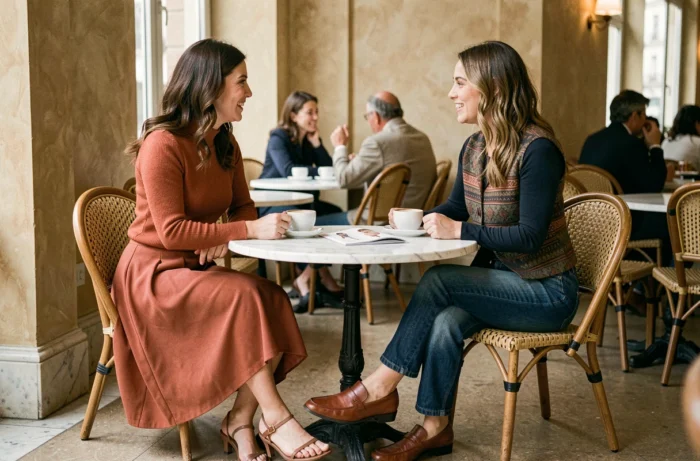
Wide-leg trousers remain the dominant cut. Worn high-waisted with a tucked-in sweater or bodysuit, they elongate the silhouette and adapt well to both professional contexts and outings. Versions in corduroy or plaid wool add texture.
The midi dress in knit or lace is the other pillar of the wardrobe. Lace, omnipresent on the runways, is now worn during the day, paired with a thick coat and flat shoes. The contrast between the delicacy of the fabric and the robustness of the surrounding pieces creates an interesting visual balance.
Textile layering: building an autumn style without overloading
The technique of layering returns every autumn, but the 2026-2027 version is distinguished by its rigor. The goal is to stack different materials without creating excessive volume.
- First layer thin and fitted: bodysuit, modal t-shirt, or lightweight shirt
- Textured intermediate layer: knit vest, flannel blazer, buttoned cardigan
- Structured outer layer: straight coat, waterproof trench, or fringed cape
- Connecting accessory: wool scarf, belt on the coat to define the waist
Each layer must remain visible, even if only by a collar, hem, or difference in texture. The principle relies on the readability of the construction rather than on accumulation.
Furthermore, the water-repellent treatments applied to outer layers are subject to strengthened restrictions in Europe, particularly regarding PFHxA substances. Brands are gradually reformulating their waterproof finishes, which alters the performance of certain waterproof coats and trenches. Checking the composition and type of treatment becomes a useful reflex when purchasing.
The autumn-winter 2026-2027 wardrobe is therefore built as much on aesthetic choices (deep red, checks, daytime lace) as on an increasing attention to materials and their regulatory framework. The trendiest piece of the season may well be the one that lasts long enough to span several winters.