The choice of garden equipment rarely hinges on the list of tools, but rather on three considerations that most guides overlook: battery compatibility between powered devices, local noise regulations, and adaptation to water constraints. Here, we detail the technical criteria that guide a sustainable purchase.
Battery platform and ecosystem locking: the real budget item
A hedge trimmer, a brush cutter, and a blower bought separately can be expensive in terms of batteries. Manufacturers now offer interchangeable battery platforms: a single cell powers multiple tools within a range. The benefits are twofold, both financial and logistical, as the number of chargers and stored batteries decreases.
The downside is proprietary locking. Switching brands after three or four tools means repurchasing the entire energy fleet. We recommend checking, before the first powered purchase, the actual extent of the compatible range: some platforms cover the mower, hedge trimmer, brush cutter, and blower, while others are limited to small tools.
To compare the ranges and available references, you can check all the equipment on Ta Maison Ton Jardin before finalizing your choice of platform.
Noise regulations and choosing thermal or battery
The power of a thermal brush cutter is appealing on paper. In practice, municipal decrees strictly regulate the hours of use for powered devices, and repeated noise can constitute a nuisance even during an authorized time slot. The time slots vary from one municipality to another: consulting the prefectural or municipal decree before investing avoids an unusable purchase on weekends.
Battery models significantly reduce noise levels compared to thermal engines. For a garden in a dense residential area, this difference is not just a comfort; it is a condition for regular use.
Criteria to check before purchasing a powered device
- Battery voltage and capacity (expressed in volts and amp-hours): these determine both cutting power and actual autonomy in the field
- Battery compatibility with other tools of the same brand, and the number of tools actually available in the platform
- Announced noise level in decibels and compliance with CE marking, which certifies adherence to European safety and emission standards
- Weight of the tool + battery combined, especially for handheld devices like the hedge trimmer or brush cutter
Hand tools for working the soil: spade, fork, and blade
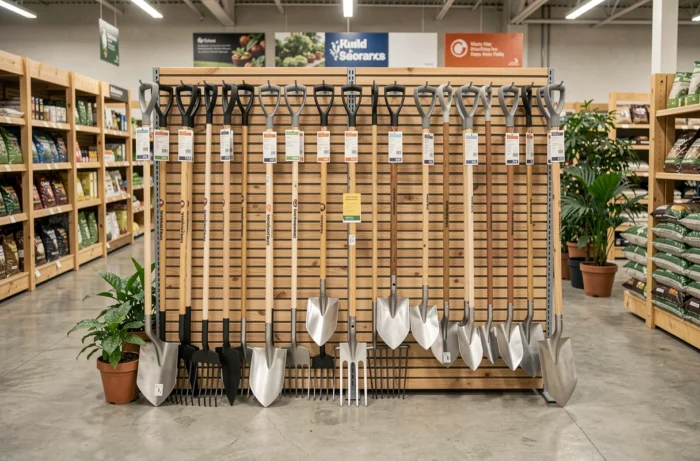
Hand tools remain the foundation of any garden equipment. The digging fork outperforms the classic spade in clayey or stony soil: its tines penetrate without compressing the earth, preserving soil structure and facilitating root work.
To turn over loose soil, a flat-bladed spade made of hardened steel is sufficient. However, compact soil requires the fork, whose tines separate clumps without cutting them. The rake is used for finishing to level and refine the surface before sowing.
Handles and ergonomics: what reduces fatigue
A wooden ash handle absorbs vibrations better than a fiberglass handle, but it is heavier. For short sessions on small terrain, ash remains the best compromise. On larger areas or for users sensitive to musculoskeletal disorders, a fiber handle with an ergonomic grip reduces strain on the wrists.
The length of the handle determines posture. A handle that is too short forces bending, while a handle that is too long shifts the effort point to the shoulders. The simple rule: standing, the top of the handle should reach between the elbow and the armpit.
Water management in the garden: equipment adapted to water constraints
Adapting to water scarcity has become a structuring criterion in the choice of outdoor equipment. Three areas deserve targeted investment.
The rainwater collector connected to a downspout is the first building block. Its capacity should be sized according to the area of the collecting roof and the actual summer needs, not just the size of the garden.
Drip irrigation, placed at the base of plants and covered with mulch, limits evaporation much better than an oscillating sprinkler. The mulch itself (wood chips, straw, bark) is not a decorative accessory: it reduces evaporation and protects the microbial life of the soil.
A garden shredder turns hedge trimmings and branches into directly reusable mulch, closing the loop between maintenance and soil protection.
Lawn mowers: operational limits to know
Lawn mowers are appealing due to their autonomy. Recent models with vision navigation (cameras and LiDAR sensors) eliminate the peripheral cable, simplifying installation. However, user feedback reports persistent issues with returning to the charging station and loss of signal on sloped or complex terrain.
Before investing, we recommend checking the maximum area announced by the manufacturer and comparing it to the actual area, taking into account obstacles, narrow passages, and elevation changes. A robot that is just the right size loses reliability as soon as the terrain becomes complicated.
The final consideration is blade maintenance. Robots use thin blades that wear out quickly and do not cut tall grasses well. A regular pass, scheduled every two or three days, compensates for this limitation by maintaining a low and consistent cutting height.